Showing posts with label california politics. Show all posts

Tuesday, May 31, 2016

California Primary Prediction: Clinton +10


After a long process, the voting primary states have nearly ended. California is not only the  biggest prize in the calendar on June 7th, it is also the largest with 475 pledged delegates. Senator Sanders is hoping a win here will weaken Secretary Clinton’s argument for the nomination while Secretary Clinton is hoping for not only a win but a decisive win that will show she is still widely popular among the Democratic base (as head to head polls currently show) and that she is the clear choice of the Democratic Party.

California has demographics that strongly favor Secretary Clinton. Despite the strong population of young people with California’s many colleges and universities and the strong progressive streak, Secretary Clinton has the strong advantage here. One poll showed Secretary Clinton ahead by only 2 points but it was taken over the span of nine days (generally too long for a poll) with a small sample size compared to another poll (Survey USA) showing her ahead by 18 points. At the same time, polling Latino voters in California has been historically difficult so it remains to be seen who Latino voters will decide to support.

Arizona and Oregon also help predict California’s results as well. Arizona has a large Latino population, mainly Mexican while California’s Latino population is extremely diverse but majority Mexican as well. This leads me to believe Secretary Clinton will win the support of the majority of the California Latinos. Oregon has a smaller percentage of Latinos (10%) but has a large population of progressive white voters in Portland and its surrounding area.

To predict Secretary Clinton’s win in California, I looked at the 2008 map where she won California by 8 points. I predict a roughly 10 point win here in 2016. Secretary Clinton will gain votes with upscale Democrats (West Coast) and with African American and lose votes with rural white voters (the Sierras) and potentially a few points with Latino voters.

This is my prediction for the 2016 Democratic primary.
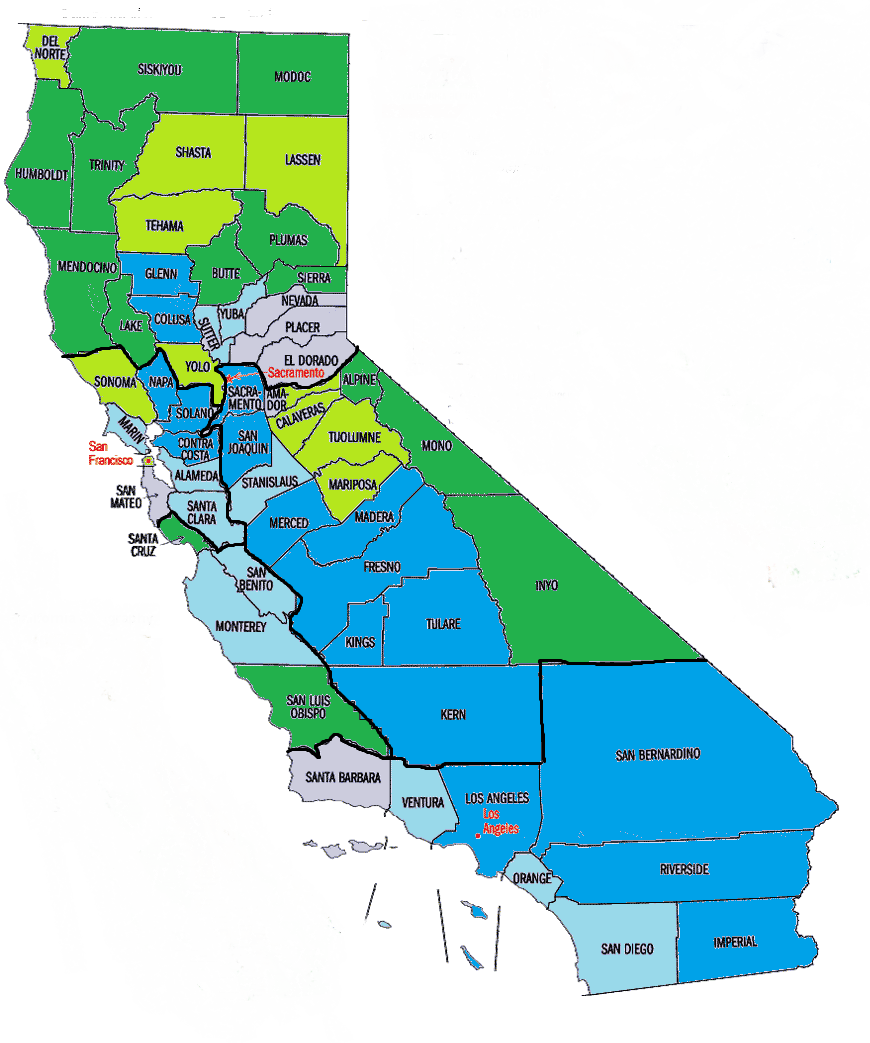
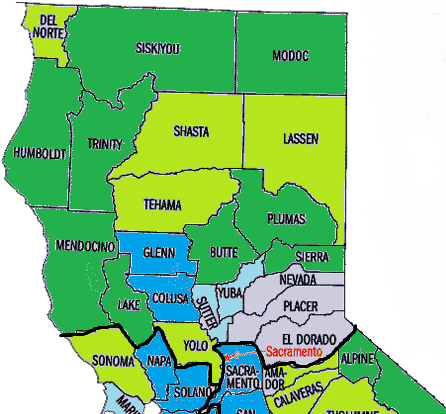
california primary map 2 lines.png
Dark Blue = Solid Clinton
Light Blue = Lean  Clinton
Grey = Tossup
Light Green = Lean Sanders
Solid Green = Solid Sanders 

2008 Primary Results as Comparison:
2008.png


Northern California:
northern california.png
Humboldt County:
This county  is a quintessential Bernie County. Not only is it heavily white (78%) and rural, it also has a large number of progressives (they are not as upscale as the Marin County progressives) and has Humboldt State University. I expect Sanders to break +20 here.

Mendocino County:
Mendocino County should vote for Senator Sanders as well but it is less favorable to him than Humboldt County. The reason is that due to the large number of wealthy Bay Area transplants here and the growing influence of the wine country (I expect Napa County which has a large number of Latinos and upscale Democrats to support Secretary Clinton) Secretary Clinton will have a base here. What will allow Senator Sanders to carry Mendocino though is the rural working class voters inland in Ukiah and Wilitis. He will also be helped by longtime residents here as well as baby boomers who settled here in the 1970s. Overall I predict a Sanders +10 here.

Border Counties:
The counties of Del Norte, Siskiyou and Modoc are all heavily white, rural and have large elderly populations (over 20% in many of them). This will allow Secretary Clinton to not face a blowout here (similarly to Oregon’s southern counties) but should not be enough for her to win any of them.

Bay Area:
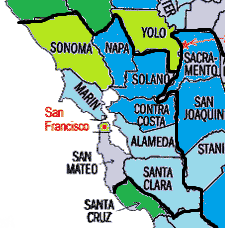
Bay Area.png
Alameda County:
This county will narrowly lean Clinton. On one hand, it has heavily African American areas (12% countywide) in Oakland and wealthier areas (Dublin) that will vote strongly for Secretary Clinton. Alameda County also has a 23% Latino and 29% Asian population. At the same time, Alameda County is also home to Berkeley which is probably one of the strongest Bernie cities in the state. It is home to extremely progressive and young Democrats (and I saw Jill Stein at an event there). The southern part of the county is more Latino which should favor Secretary Clinton but Berkeley has high Democratic turnout and the hipsters in Oakland may offset the African American voters there supporting Secretary Clinton. Overall I predict Secretary Clinton +4 due to the southern part of Alameda County saving Secretary Clinton.   

Contra Costa County:
If  any county in the Bay Area were made for Hillary, it would be this one. Not only does Contra Costa have a 10% African American population (it is home to heavily African American city of Richmond), it also has very upscale suburbs similar to the Philadelphia suburbs and the Upper East Side that Hillary won. There are a few working class areas (Martinez) but they should be outvoted by the wealthier areas (Lafayette, Walnut Creek, Danville). I predict a +17 Secretary Clinton win here.

Marin County:
As a resident of Marin County, I am so excited to finally discuss how my county will vote. At a first glance, Marin County appears to be strongly for Bernie. It is 72% White and very progressive (it was the strongest Obama primary county in California in  2008, backing him by 19 points). Environmentalism is the key issue here, we love hiking in the redwoods on Mt. Tam, we love our salmon, we love protecting our unspoiled coastline and we love our four Whole Foods markets. One town, Fairfax is a proud town with many former hippies very proud of its heritage (and West Marin is very similar with many rural progressives). On the other hand, there are some very wealthy areas in Marin County (Tiburon, Ross) which are still Democratic but many of the Dems there are more moderate and similar to upscale Democrats Secretary Clinton won on the East Coast. The average age is also 44 years old. The bellwether here is Mill Valley which is home to many progressives and many upscale Democrats (there are two Whole Foods within a mile of each other). At the same time, Marin County may appear very pro Secretary Clinton on a data model due to demographics similar to Montgomery County, PA, Montgomery County, MD and Westchester County which overwhelmingly backed Hillary, I expect Marin County to be very close due to the strong progressivism and activism many of the Democrats here have. While I expect the West Marin/Fairfax contingent to post a strong showing for Bernie, Marin will support Hillary  thanks to supporters in the southern part of the county. I predict Clinton +4 here.  

San Mateo County:
The key to determining how San Mateo County votes is by looking at the divide between the areas along the Bay which are full of young tech workers. The upper parts of the county though are more older (Hillsborough, Woodside) and more wealthy which would imply a win for Secretary Clinton. San Mateo County is currently labeled as “too close to call” thanks to the large numbers of tech workers here (and Senator Sanders is also helped by the working class residents of South San Francisco). Secretary Clinton also won here in 2008 by six points despite losses among the young tech workers (although provided there are more now than in 2008). Overall, I give this county Clinton +1 but with the potential closeness it is marked as “too close to call” on the map.

Santa Clara County:
At a first glance, Santa Clara County may appear to be a swing county due to the large number of young people working in Silicon Valley. Once one leaves the valley however and heads to the mountains, the demographics change and become more upscale (Campbell, Saratoga, Mountain View etc), which favors Secretary Clinton. As shown in Oregon, Sanders won wealthy suburban areas in Portland (Clackamas County) by three points (I am using it to compare upscale Democrats on the West Coast) but Clackamas County is not as wealthy as parts of Santa Clara County and it does not have the minority population Santa Clara has. Also, Santa Clara County has a significant Latino population (26%) which is the largest in the Bay Area. The Asian population here is 35% and while there is little data on how Asian Democrats vote in the primary (especially Vietnamese due to the large Vietnamese population here), the best data we have is the NY primary results where Secretary Clinton won 60%-65% in heavily Asian neighborhoods. While Santa Clara County and San Mateo County are similar demographically in some ways, what gives Secretary Clinton a higher percentage here than in San Mateo is the higher Latino population. Also, Secretary Clinton won by 13 points here in 2008 despite President Obama winning  among the young tech workers. In terms of polls, the best data here is a Clinton +13 poll here which is a bit out of line with our Secretary Clinton +5 win here.

San Francisco County:
While demographics of many California counties may appear obscure, what is not obscure is the San Francisco demographics. With a large population of progressive voters and young voters, San Francisco is prime territory for Senator Sanders. At the same time here, he will not win a blowout here that he will need to counterbalance Secretary Clinton’s wins in SoCal. The reason is that many of the wealthy voters in the Pacific Heights will favor Secretary Clinton. The Asian voters in the Sunset District will probably favor Secretary Clinton (but as shown by heavily Asian areas in NY, probably not by large margins). Overall, I predict a +7 Sanders win here, thanks to margins from young voters and from progressives.

Central Coast:
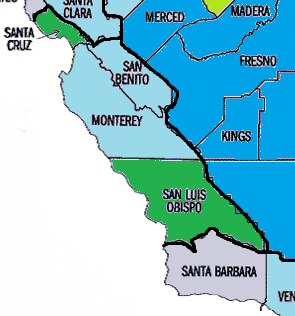
Central Coast.png
This region contains Santa Cruz, Monterey and San Luis Obispo Counties.

Santa Cruz County:
Santa Cruz county is similar demographically to Marin County. There are many environmental progressive voters here as well as UC Santa Cruz and Watsonville which is heavily Latino (Santa Cruz County is 30% Latino). While Watsonville should lean Secretary Clinton, it should be outvoted by the rest of Santa Cruz County which I expect to heavily back Bernie. I expect Sanders +7 here.

Monterey County:
Monterey County similarly to 2008 will mostly likely go for Hillary. Not only is it 57% Latino, it also has a large upscale white voter population. At the same time, it is important to note that due to the low turnout rates of Latinos, a 57% Latino population does not guarantee a Latino majority in voting, even in a Democratic primary (in a general election a 65% Latino area may have a majority Latino vote) due to the age of many of the voters. While many of these voters are strong environmentalists similarly to Santa Cruz and Marin Counties, many of these voters are very upscale and may not be progressive activists the way voters in Marin and Santa Cruz Counties are. I expect Secretary Clinton to win here by roughly 10%.

San Luis Obispo County:
With Cal Poly, a smaller Latino percentage than nearby counties (and the smallest percentage in a coastal county south of the Bay Area) and a large number of rural progressives, San Luis Obispo County should vote strongly for Senator Sanders. I predict Sanders +10 here.


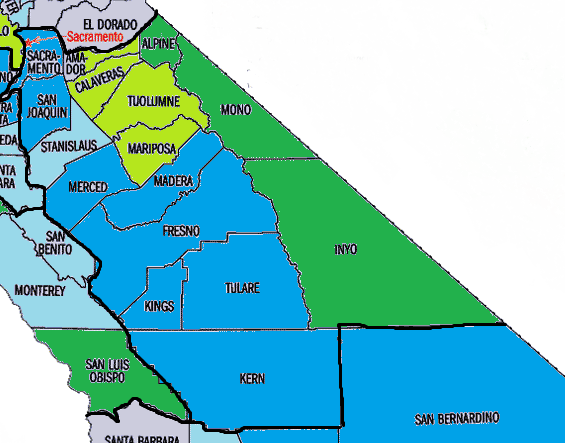
Central Valley:
Central Valley.png
Sacramento County:
Sacramento County will probably vote for Secretary Clinton but not by a large margin. The reason is that there is a large young population here in Downtown Sacramento. At the same time, this is the state capitol with political people who would be more likely to support Secretary Clinton. Not to mention the African American population here is 11%  and the Latino population is 23%. Compared to Marion County in Oregon with Oregon’s state capital which narrowly backed Bernie and had a similar Latino population, Sacramento County should back Secretary Clinton by roughly 12% thanks to the additions of the African American and Asian populations.

Stanislaus County:
If there is one farming county Senator Sanders wins, it will be this one. As shown in the 2012 election results, President Obama won here despite Stanislaus County having a 44% Latino population here (counties in the southern Central Valley with Latino populations in the 50s voted for Romney). This shows that there is a contingent of white Democrats here that may be much smaller in southern Central Valley counties. Also, many of the white Democrats here are working class, giving Senator Sanders an opening. I still expect a Secretary Clinton win but it could be close.

Merced County:
Despite the 58% Latino population here, this is a county where Senator Sanders may make a close race. The reason is that UC Merced is here and Senator Sanders performs very well with college students. I predict a +10 win for Secretary Clinton with the large Latino population carrying her to victory.

Kern County:
This county is heavily Latino with a large young population as well (30% of the population is under 18). At the same time, many of the Latinos here are involved in the farmworking industry which favors Secretary Clinton due to the strong support she received there. Also, the white population here is strongly Republican, preventing Senator Sanders from narrowing the margin here with white working class voters. I predict a +20 Secretary Clinton win here.

Southern California:
Southern California.png
Santa Barbara County:
In California elections, Santa Barbara County is a bellwether. It is a good representation of the state. It has a liberal university, it has wealthy liberal voters, it has heavily Latino communities in an urban area (East Santa Barbara), it has heavily Latino communities in an agricultural area (Lompoc, Santa Maria), it has upscale Republicans (Montecito), and rural Republicans (Santa Ynez). Therefore, I expect Santa Barbara to represent the state of California and have the Latinos and the wealthy voters carry Secretary Clinton to victory. My prediction is Secretary Clinton + 2.

Ventura county:
As recently as 10 years ago, Ventura County leaned Republican but demographic changes have changed that. Not only has the Latino population grown to 42%, the formerly heavily Republican suburban areas such as Thousand Oaks have become more purple instead of solidly red (although Simi Valley is still solidly red). I expect Clinton to win here  by +12.

Los Angeles County:
If Secretary Clinton wants a large margin out of California, Los Angeles will be the county where she needs it and she will get it. Besides Silver Lake and other young areas in LA County, there are few opportunities for Senator Sanders. There are upscale wealthy areas but they are unlikely to back Bernie (except maybe Santa Monica) due to not being as “anti establishment” as the progressive areas in Marin and Santa Cruz Counties. Not to mention Los Angeles County has a 48% Latino population and a 9% African American population that is very politically active. In 2008, Secretary Clinton won California by 12, I expect her to keep her 2008 voters (the groups she lost in 2016 compared to 2008 are working class white voters and there are few in LA County) and she will gain among African American voters and upscale white voters. Therefore, I predict a +16 win for Secretary Clinton here.

Orange County
This is a difficult county to predict. Orange County on one hand is home to a large Latino population (34%) and Asian population (16%) and also has many wealthy coastal areas as well that should favor Secretary Clinton. Secretary Clinton should be able to at least receive a +10 margin here thanks to margins from the coastal areas and from Latinos (although her margins among Latinos here may be smaller than in other areas thanks to the Latino population being younger here than in other parts of California).

San Diego County:
With San Diego being much whiter and younger, this is the SoCal county Sanders has the best chance to win (although I highly doubt he does). San Diego County has a large college aged population and has a larger white percentage than other SoCal counties (at 47% which also means that not a single county in SoCal is majority non Hispanic White). The 33% Latino population though is very helpful to Secretary Clinton and the 6% African American and 12% Asian do not hurt either here. Overall, Secretary Clinton should aim for a +8 win here.


Imperial County:
Predicting how Latinos will vote in California is difficult with Latinos having different voting patterns across the U.S. In Illinois, Sanders won the 75% Latino 4th district (but most of the Latino population was not Mexican) and Secretary Clinton won in heavily Latino parts of Florida and Texas (and probably won in Nevada but others debate that and that is another discussion for another article). I settled on Arizona, due to the similarities in the Latino population and the fact that both states are not caucus states (Nevada is). Yuma County and Santa Cruz County, the two heavily Latino counties in Arizona supported Secretary Clinton +29 and +32 respectively (similar to their 2008 primary results). While Senator Sanders has a chance to make inroads among urban Latinos, he has not shown this ability with rural ones. This is important in a 82% Latino county such as Imperial County. Therefore, I am predicting a +40 margin here for Secretary Clinton (similar to her +44 margin in 2008).

Conclusion:

Overall, Secretary Clinton should expect a +10 win statewide. She will sweep every county in SoCal with the closest being San Diego and Santa Barbara Counties. She will win the cities in the Central Valley (with the potential exception of Stanislaus County (Modesto) and while she will lose the Sierra rural areas, she may not lose by the large margins she lost by in rural western caucus states thanks to the large elderly population in these areas.

In NorCal, the race will be more split with Secretary Clinton winning the East Bay in the Bay Area, losing San Francisco and keeping it close in Santa Clara, San Mateo and Marin Counties.

In Coastal California, Bernie will win most of the counties except for Monterey.

California will be a gripping end to the primary season and while we may not know the final tallies for over a month (California takes about a month to finalize the provisional ballots and counts absentee ballots first which should favor Secretary Clinton in the early count), the absentee ballots and the Election Day votes should be enough to allow Secretary Clinton to declare victory.

Overall, the main reason I believe Secretary Clinton will win by 10 points in California is that in 2008, she won by eight points showing that she has a strong base here and Senator Sanders would need to make inroads among one of her demographics. I have not seen how Senator Sanders can do it.

Thursday, July 30, 2015

California Redistricting: What Could Have Happened

In late June of 2015, the marriage equality case was the Supreme Court case received the most attention. At the same time, the Supreme Court ruled that redistricting commissions (non elected people who are Democrats, Republicans and Independents) can draw redistricting maps. This works out well for Democrats because Republicans have recently drawn convoluted maps across the country including a map with 12-4 Republican districts in Ohio even though President Obama won Ohio in 2012. One district in Florida (drawn by Republicans) represents parts of Orlando and Jacksonville that are almost 200 miles away from each other. Also, if the Supreme Court ruled against the commission, Arizona which has a commission would have redrawn its map and given two seats to the Republicans. In California though, the Democrats would have had to do a mid decade redistricting.

My map shows what the Democrats could do if the Supreme Court ruled the commission unconstitutional and the Democrats performed mid decade redistricting. This map shores up many of their vulnerable incumbents who won close races in 2014. It is a 43-10 Democratic map. While the Democrats could try to draw a 45-8 map, that would cause them to create more convoluted lines and if "good Government groups" lobbied against a strong gerrymander, many Democrats  may decide to go for a map that does not have convoluted lines and mostly respects communities of interest while still increasing Democratic chances in four Republican held districts. Also, many Democratic incumbents will not want drastic changes in their district lines so I did not make major changes to Bay Area seats and many LA ones. I also followed the Voting Rights Act which requires districts to be drawn to elect Hispanic, African American and Asian representatives.

Overall, the map I drew aims to add four new Democratic seats without strongly violating communities of interest and having convoluted lines.

The current map is here and here

The current data is here:

Unless the district is listed below, there were no changes made.

New Map Data:

 (Northern California) 

New Data: (the new data is not as accurate for larger counties such as Los Angeles unless it is the 2008 election. Also, all percentages are based on the two party vote).

Sacramento Area: 

District 3: John Garamendi (D) Likely Democratic Purple
Political Data: (2012): Obama 56.5% (2008): Obama 57.1% (2010 Gubernatorial): Brown 54.4%
Demographics 18+: W 54%, AA 6%, Asian 11%, H 24%

The 3rd district becomes a point more Democratic by losing all of Sacramento County and gaining part of Democratic leaning West Sacramento. Garamendi has successfully held this district in 2014 and should continue to represent it.

District 6 Doris Matsui (D) Safe Democratic Teal
Political Data: (2012): Obama 62.9% (2008) Obama 62.9% (2010 Gubernatorial): Brown 63.3%
Demographics 18+: W 54%, AA 9%, Asian 12%, H 20%

The 6th district increases from 30% R to 37% R by adding the Citrus Heights area but remains safely Democratic.

District 7 Ami Bera (D) Likely Democratic Grey
Political Data: (2012): Obama 57.4% (2008): Obama 57.3%, (2010 Gubernatorial): Brown 56.9%
Demographics 18+: W 51%, AA 10%, Asian 18%, H 16%

The 7th district becomes more Democratic by removing the Citrus Heights area and adding southern Sacramento. The 2008 Obama percentage increases from 52.7% to 57.3%, meaning Rep. Bera would have won by nine points in 2014. With the higher Democratic percentages, after 2016, the 7th district will no longer hold the title of the district with the most expensive congressional race.

Central California

District 10 Jeff Denham (R) Safe Republican Pink
Political Data: (2012): Obama 43.4%, (2008): Obama 43.1%, (2010 Gubernatorial): Brown 37.8%
Demographics 18+: W 60%, AA 3%, Asian 12%, Hispanic 27%

The 10th district becomes more Republican at it loses  Democratic parts of Stanislaus County (Modesto) and gains heavily  Republican parts of Merced, Madera and Fresno Counties (including Clovis). Denham will have no trouble here.


District 16 Jim Costa (D) Likely Democratic Green
Political Data: (2012): Obama 61.2% (2008): Obama 60.9% (2010 Gubernatorial): Brown 56.2%
Demographics 18+: W 35%, AA 4%, H 52%, Asian 7%

The 16th district undergoes major changes. It loses all of Fresno, parts of Merced County and gains Democratic leaning Tracy in San Joaquin County, Democratic leaning parts of Stanislaus County, Gilroy in Santa Clara County, San Benito County and heavily Hispanic parts of Monterey County. The 16th district is rated as "Likely Democratic" because Costa had a close race in a similar district in 2014 but the addition of Tracy (it has higher turnout) and Monterey County should  help protect Costa. Also, there is a chance State Sen. Anthony Cannella (R) who represents a district with similar lines may run but the district he represents is more Republican, making  the 16th district easier for Democrats to win.

Sidenote: Merced County is split under this map and Section 5 of the VRA prevents that but in 2013, Section 5 was found unconstitutional so I chose to split Merced County.


District 20 Sam Farr (D) Safe Democratic Pink
Political Data: (2012) Obama 70.0%, (2008): Obama 70.4%, (2010 Gubernatorial): Brown 64.9%
Demographics 18+: W 47%, AA 3%, H 41%, Asian 6%

The 20th district undergoes a major change as it loses some heavily Hispanic parts of the Salinas Valley to the 16th district which has similar lines to SD-12. The 20th district then gains heavily Republican Kings County but remains strongly Democratic.

District 21 David Valadao (R) Tilt Democratic Dark Brown
Political Data: (2012) Obama 55.0%, (2008): Obama 54.8%, (2010 Gubernatorial): Brown 53.4%
Demographics 18+: W 22%, AA 5%, H 67%, Asian 4%

The current 21st district voted for President Obama but is represented by a Republican because the Republican has a strong base in Kings County which has high turnout. Also, many of the rural Hispanic voters (especially in Fresno County) are swing voters. The Kern County part votes strongly Democratic however. The new 21st district removes all of Kings and western Fresno Counties and instead adds heavily Hispanic parts of Tulare county where Rep. Valadao does not have a base. Without his base in the district, Valadao may attract a strong challenger such as Assm. Salas who represents Democratic parts of Kern County. Also, the real Obama 2012 percentage is probably close to 57% due to the heavily Hispanic parts of the Central Valley swinging further to Obama than the rest of the counties it represents did.

District 22 Kevin McCarthy (R) vs. Devin Nunes (R) Safe Republican Brown
Political Data: (2012) Obama 35.4%, (2008): Obama 35.4%, (2010 Gubernatorial): Obama 34.0%
Demographics 18+ W 62%, AA 3%, H 28%, Asian 4%

The 22nd district gains heavily Republican parts of San Luis Obispo County and parts of Tulare County. By being the Majority Leader, McCarthy should be safe from a primary challenge from Rep. Nunes. Nunes may run in the 21st district but probably would lose to Valadao in a primary.


District 23 Open Likely Democratic
Political Data: (2012) Obama 59.5% (2008) Obama 59.8%, (2010 Gubernatorial): Brown 55.3%
Demographics 18+: W 28%, AA 6%, H 55%, Asian 9%

This new district represents heavily Hispanic parts of Fresno (city) as well as western Fresno County. With the strong anchor of Fresno City and more straight ticket urban Democrats, Democrats should be extremely favored here. If Rep. Costa stays in the 16th, Assm. Perea or Assembly candidate Arambula may consider this seat.


Southern California: 

District 24 Open Likely Democratic Dark Purple
Political Data: (2012) Obama 58.3%, (2008) Obama 60.6%, (2010 Gubernatorial) Brown 52.7%
Demographics 18+: W 62%, A 2%, H 30%, Asian 5%

The 24th district loses Republican parts of San Luis Obispo County and gains Ventura in Ventura County, increasing the Democratic percentage by a few points. With a competitive congressional race brewing here, this change should make the district much more Democratic.

District 25 Steve Knight (R) Likely Democratic Tan/Pink
Political Data: (2008) Obama 56.7%, (2010 Gubernatorial) Brown 50.3%
Demographics 18+: W 49%, AA 9%, H 32%, Asian 8%

The 25th district loses heavily Republican Simi Valley and Santa Clarita and instead traverses the San Gabriel Mountains and gains Burbank and part of Glendale. This area has high turnout even during midterms and I find it hard to see Burbank/Glendale voters ticket splitting for Knight, an Antelope Valley Republican.

LA Metropolitan Area

District 26 Julia Brownley (D) Likely Democratic
Political Data: (2008) Obama 57.7% (2010 Gubernatorial) Brown 49.5%
Demographics 18+: W 48%, AA 2%, H 39%, Asian 8%

The 26th district's partisanship stays stable as it loses Thousand Oaks and gains Simi Valley and Democratic leaning parts of the San Fernando Valley west of the 22. Brownley may want more Democratic votes but she won in 2014, a horrible year for Democrats against the Republican "dream" candidate. The district will only continue to trend Democratic as the Hispanic population increases. Brownley can continue to send her weekly fundraising emails.

District 28 Adam Schiff (D) Safe Democratic Pink Gray (representing Beverly Hills)
Political Data: (2008) Obama 75.6% (2010 Gubernatorial) Brown 70.6%
Demographics 18+: W 60%, AA 3%, H 20%, Asian 14%

The 28th district loses most of Burbank/Glendale and goes as far west as the 405 in the Westside. Schiff should be safe from a primary challenge but when he retires, I expect a major Westside battle for this seat.

District 29 Tony Cardenas (D) Safe Democratic Green/Gray (representing San Fernando Valley)
Political Data: (2008) Obama 75.9% (2010 Gubernatorial) Brown 72.6%
Demographics 18+: W 22%, AA 4%, H 63%, Asian 9%

A few minor changes. None of them should affect Cardenas.

District 30 Brad Sherman (D) Safe Democratic Orange/Pink (representing San Fernando Valley)
Political Data: (2008) Obama 62.9%, (2010 Gubernatorial) Brown 55.1%
Demographics 18+: W 55%, AA 4%, H 26%, Asian 13%

Sherman helps the team out by gaining Republican leaning Santa Clarita. Sherman however should be safe with his San Fernando Valley base anchoring his district.

District 31 Pete Aguilar (D) Likely Democratic Light Yellow (representing San Bernardino)
Political Data: (2008) Obama 58.3%, (2010 Gubernatorial) Brown 54.4%
Demographics 18+: W 34%, AA 11%, H 46%, Asian 8%

The 31st district mostly remains the same. It still leans Democratic and should continue to trend Democratic as the Hispanic population grows. Aguilar won here in 2014 so as long as two Republicans and another Democrat challenge him at the same time, he should be safe.

LA County 
District 33 Ted Lieu (D) Safe Democratic (Blue, representing LA Coast)
Political Data: (2008) Obama 63.0%, (2010 Gubernatorial) Brown 53.8%
Demographics 18+: W 73%, AA 3%, H 11%, Asian 11%

If one Democrat is not happy with the map, Lieu might be that Democrat. The 33rd district loses all of the Westisde east of the 405 and gains Thousand Oaks which narrowly leans Republican. At the same time, the 33rd district gains all of Westchester. Seeing how Lieu won by 16 points in 2014, a Republican year, he should be safe but may have to campaign a little bit in Republican years.

District 35 Norma Torres (D) Safe Democratic Purple (representing San Bernardino County)
Political Data: (2008) Obama 65.9%, (2010 Gubernatorial) Brown 62.9%
Demographics 18+: W 20%, AA 7%, H 64%, Asian 8%

Besides a few minor changes, the district remains similar. Torres should be safe.

District 36 Raul Ruiz (D) Likely Democratic Orange (representing Riverside County)
Political Data: (2008) Obama 53.8%, (2010 Gubernatorial) Brown 48.8%
Demographics 18+: W 48%, AA 5%, H 41%, Asian 4%

Ruiz's district becomes two points more Democratic as it loses part of Hemet and gains part of Moreno Valley. I decided not to trade more of Hemet and Moreno Valley in order to prevent the 41st from being too convoluted. Anyway, Ruiz won by 8 points in 2014, a Republican year against a strong candidate (Assm. Nestande) showing that Ruiz is popular. Also, Brown in 2014 overperformed Obama in 2012, the only district where he did so in the Inland Empire, showing the 36th is trending Democratic very quickly.

District 37 Karen Bass (D) Safe Democratic Light Blue (representing Central LA)
Political Data: (2008) Obama 87.2%, (2010 Gubernatorial) Brown 84.1%
Demographics 18+: W 26%, AA 26%, H 35%, Asian 10%

There are a few small changes but Bass's district remains one of the most Democratic in California and the country.

District 38 Linda Sanchez (D) Safe Democratic Turquoise (representing southeast LA County)
Political Data (2008) Obama 63.3% (2010 Gubernatorial) Brown 60.6%
Demographics 18+: W 22%, AA 3%, H 57%, Asian 17%

The 38th district gains heavily Hispanic precincts in La Habra and a few near Long Beach. Otherwise, it does not change and remains heavily Hispanic and Democratic.

Orange County/Inland Empire
District 39 Ed Royce (R) Safe Republican Light Tan (representing Orange County)
Political Data: (2008) Obama 44.2%, (2010 Gubernatorial) Brown 34.2%
Demographics 18+: W 54%, AA 2%, H 18%, Asian 23%

The 39th district becomes more Republican. It loses Democratic leaning Buena Park and southern Fullerton. It gains heavily Republican parts of southern Orange County. Royce should not have major problems.

District 41 Mark Takano (D) Safe Democratic Grey (representing Inland Empire)
Political Data: (2008) Obama 58.5%, (2010 Gubernatorial) Brown 54.6%
Demographics 18+: W 33%, AA 8%, H 50%, Asian 7%

The 41st district becomes a point more Republican as it loses part of Moreno Valley to the 36th but the 58.5% Obama number should be enough to protect Takano.

District  42 Ken Calvert (R) Safe Republican Green (representing Inland Empire)
Political Data: (2008) Obama 43.9%, (2010 Gubernatorial) Brown 37.5%
Demographics 18+: W 53%, AA 5%, H 30%, Asian 9%

The 42nd district gains part of Hemet and loses heavily Hispanic parts of Corona. It remains Republican by representing conservative parts of southern Riverside County.

District 43 Maxine Waters (D) Safe Democratic Light Pink (representing South LA area)
Political Data: (2008) Obama 75.6%, (2010 Gubernatorial) Brown 71.8%
Demographics 18+: W 17%, AA 23%, H 42%, Asian 15%

The 43rd district gains a few Republican leaning precincts in Torrance to strengthen the 33rd but remains strongly Democratic.

District 44 Open (Nanette Barragan (D) vs. Isadore Hall (D)) Safe Democratic Dark Pink (representing Compton)
Political Data: (2008) Obama 81.7% (2010 Gubernatorial) Brown 80.3%
Demographics 18+: W 11%, AA 17%, H  63%, Asian 7%

The 44th district becomes a point more Republican by gaining marginal precincts in Long Beach to shore up the 47th district.

District 45 John Campbell (R)? Leans Democratic Light Blue (representing Orange County)
Political Data: (2008) Obama 56.6% (2010 Gubernatorial) Brown 46.1%
Demographics 18+: W 45%, AA 2%, H 30%, Asian 21%

The 45th district is the 2nd Democratic district in Orange County. It is a combination of Rohrabacher and Campbell's seats. It represents half of heavily Hispanic Santa Ana, Democratic leaning parts of Costa Mesa, Democratic leaning Irvine and Laguna Beach. Some may argue that this seat leans Republican due to Brown receiving 46% here in 2010. Part of that can be attributed to Whitman performing extremely well with high income voters (it is unknown but likely that Brown won this district in 2014). The major ticket splitters in Orange County are the Vietnamese voters mainly located in Garden Grove and Westminister  which are in the Republican 48th district. The Asian voters in Irvine and the  Hispanic voters in Santa Ana are less likely to ticket split, therefore preventing a scenario similar to SD-34 where the Vietnamese voters overwhelmingly supported Janet Nguyen (R) even though many of them backed President Obama in 2012 as shown by data from Garden Grove, a heavily Vietnamese community in SD-34 but not in the 45th district. Former Irvine Mayor Sukhee Kang could be a strong fit for this district. Also, with Democrats winning narrowly Democratic leaning districts with high  numbers of upscale White voters in CA-26 and CA-52, it shows that these voters who voted Republican in the early 2000s are open to voting for Democrats on a congressional as well as Presidential level.

District 46 Open Safe Democratic Brown (representing Central Orange County)
Political Data: (2008) Obama 58.7% (2010 Gubernatorial) Brown 53.6%
Demographics 18+ W 25%, AA 2%, H 56%, Asian 15%

The 46th district becomes more Republican as it loses part of heavily Democratic Santa Ana and gains less Democratic southern Fullerton and Buena Park. While Rep. Loretta Sanchez (D) may not run for House because she is running for Senate (even after he "wha wha wha wha" moment where she "mimicked" Native Americans). Lou Correa (D) has expressed interest in this seat. The 15% Asian population is primarily Vietnamese but it is not large enough to make an impact even with ticket splitting as the 2010 race showed.

District 47 Alan Lowenthal (D) Likely Democratic Light Grey (representing Long Beach)
Political Data: (2008) Obama 58.9% (2010 Gubernatorial) Brown 49.8%
Demographics 18+: W 50%, AA 8%, H 26%, Asian 13%

The 47th district loses Garden Grove and gains most of Huntington and Newport Beaches which are Republican. At  the same time, the 47th district gains some heavily Hispanic areas in western Long Beach. The Orange County portion of the district is Republican but the addition of the Hispanic precincts in Long Beach should help counterbalance it. Also, Lowenthal won the 47th district in 2014 by 12 points, showing he can win this district even in a Republican year.

District 48 Vacant Dana Rohrabacher (R)? Safe Republican Orange/Brown (representing Orange County)
Political Data: (2008) Obama 45.9% (2010 Gubernatorial) Brown 39.9%
Demographics 18+: W 42%,  AA 2%, H 23%, Asian 31%

Do not be fooled by the high percentage of minorities in the 48th district. This district is solidly Republican by combining heavily Republican parts of Fullerton with heavily Republican parts of Huntington Beach and heavily Vietnamese Garden Grove. Rohrabacher would probably prefer to run here instead of the 47th which has much of his current territory. The 48th district is much more Republican than the 47th and does not have an incumbent.

District 49 Darrell Issa (R) Safe Republican Brown (representing North County)
Political Data: (2008) Obama 47.6%, (2010 Gubernatorial) Brown 37.6%
Demographics 18+: W 65%, AA 3%, H 22%, Asian 8%

Issa's district becomes a few points more Republican. The former car thief will be safe.

San Diego:

District 50 Duncan Hunter Jr. (R) Safe Republican (light blue)
Political Data: (2008) Obama 40.3%,(2010 Gubernatorial) Brown 33.7%
Demographics 18+: W 63%, AA 2%, H 26%, Asian 6%

A few minor tweaks but the district remains one of the most Republican in California.

District 51 Juan Vargas (D) Safe Democratic (brown)
Political Data: (2008) Obama 65.1%, (2010 Gubernatorial) Brown 62.0%
Demographics 18+: W 20%, AA 7%, H 62%, Asian 9%

A few tweaks here too. The district remains heavily Hispanic and Democratic.

District 52 Scott Peters (D) Safe Democratic (green)
Political Data: (2008) Obama 60.8%, (2010 Gubernatorial) Brown 50.3%
Demographics 18+: W 65%, AA 3%, H 12%, Asian 17%

The 52nd district becomes more Democratic as it loses Republican leaning areas in northern San Diego and gains neighborhoods near Downtown. These changes would meant that Peters would have won in 2014 by double digits. He should be fine with the 60.8% Obama numbers and this should deter major Republican challengers.

District 53 Susan Davis (D) Safe Democratic (white)
Political Data: (2008) Obama 61.6% (2010 Gubernatorial) Brown 55.5%
Demographics 18+: W 46%, AA 8%, H 29%, Asian 14%

The district becomes a few points more Republican but should remain strongly Democratic and safe for Rep. Davis.


Thursday, March 20, 2014

Welcome to the Six State California Part I

California with its 55 electoral votes used to be a competitive state in national elections that leaned Republican. In 1992 though, California voted for Clinton by 14 points and never looked back. California now is Democratic and voted 60% Obama in 2012. California is next to impossible for Republicans to win because of the Hispanic vote, Republicans would need to win 60%+ of the white vote to even get close which is hard to do because of the Bay Area and Los Angeles liberals. 2010 was the last hurrah for Republicans with Meg Whitman who was a Silicon Valley billionaire who was pro choice, not extremely anti gay but extremely rich and still lost by 13 points. Fiorina, another rich Silicon Valley former CEO lost by 10 points, despite running against one of the most liberal members of the Senate in the best year possible for Republicans. All statewide offices are held by Democrats and there seem to be no registered Republicans running who are serious contenders for any of those offices.

A recent initiative though may go on the ballot which will split California into six states. A Silicon Valley billionaire is funding the signature process. If there are enough signatures, the measure will go on the ballot this November. If California passes it, then Congress will need to approve the measure. It is unlikely that both the House and Senate would approve this measure because the Republicans would not want extra Democratic Senators that West CA, North CA and Silicon Valley would likely send and Democrats would not want to risk losing some of California's electoral votes. This post though will examine hypothetically who would run for the newly created statewide offices in each state if California's voters and Congress managed to approve this measure. Also, while predicting which candidates will run for statewide office, the article will not always specify which statewide office a candidate will run for if she does not seem to have a clear preference for Governor or Senator. The author however does oppose this measure and will vote against it if it reaches the ballot.

Disclaimer: None of these politicians I list in my post have announced any plans to run for any of the positions. These are just my predictions.

Map of six proposed states:
Blue = Jefferson
Green = North California
Purple = Silicon Valley
Yellow = Central Valley
Red = West California
Teal = South California

Jefferson: 
Presidential vote 2012: Obama 48.5%, Romney 51.5%
Gubernatorial vote 2010: Brown 47.7%, Whitman 52.3%

Jefferson is the smallest state with about 900,000 people. It represents rural Northern California covering the California coast with the Mendocino and Humboldt County areas and the Inland Central Valley with the Redding area. There have actually been several secession attempts from counties in Northern California to form their own state called Jefferson (as recently as September of2013, Siskyou County's Board of Supervisors voted 4-1 to secede) so this has been an ongoing issue in this part of the state. Overall, the state would lean Republican thanks to the heavily Republican Central Valley and high desert (Lassen and Modoc Counties in the northeast corner of the state are usually the two most Republican counties in statewide elections,) but Mendocino and Humboldt Counties in the western part of the state help keep the Republican margin narrow and could allow Democrats to win statewide with the right candidate.

Statewide offices:
 It is possible that State Assemblymember Wesley Chesbro (D) from Eureka would run for statewide office. He is well liked in the North Coast but would have to work to appeal to voters in the Central Valley. State Sen. Ted Gaines (R) from the Central Valley may run too. Another candidate for statewide office to watch would be Rep. Doug LaMalfa (R), the newly elected Representative from California's 1st district. He has a strong base in the eastern part of the state representing more than half of the state's constituents and he is well known there too due to his tenure as a State Senator. A potential Democratic candidate is Rep. Jared Huffman (D) who represents the North Coast and is well liked in the district. His views on the environment will work well with voters in Mendocino and Humboldt but the district's voters in the Central Valley are less pro environment and will likely side with LaMalfa. Also, Huffman may be accused of carpetbagging because he lives in Marin County which is not part of Jefferson. It is possible however that Huffman will run in the state of North California which contains Marin County (more on that in the North California description.) Rep. Mike Thompson (D) may consider returning to the district because he represented the North Coast until 2010 so the voters will probably remember him and his tenure there will make attacks on him as a carpetbagger less harmful. Also, Thompson has a reputation as a moderate and won tough races when his district was competitive in the 1990s so he could run a strong campaign to win statewide.

Overall, generic Democratic vs. generic Republican would be Tilt Republican. If Democrats nominate a moderate such as Thompson or a well funded candidate such as Huffman, then the statewide races should be Tossup. 

North California: 
2012 Presidential vote: Obama 59.9%, Romney 40.1%
2010 Gubernatorial vote: Brown 57.8%, Whitman 42.2%

Description:
Unlike Jefferson which clearly represents the rural northern part of California, North California does not have a major center or geographical area. North California represents Marin and Sonoma Counties which are both heavily Democratic. North California then goes to the east and covers Napa County as well as industrial Solano County. North California then takes in the Sacramento area as well as some conservative suburban areas in it which makes the state less Democratic but still strongly Democratic. The state is torn between higher income portions of the Bay Area, industrial areas and the Sacramento area so there could be some competitive primaries for offices here.

Statewide offices:
 Marin and Sonoma Counties should keep the state Democratic (they are some of the few Democratic areas that have low dropoff in midterms,) so the primaries will be the most important. State Senate President Darrell Steinberg (D) could consider running for Governor here and he should win the primary based on his connections in the California Legislature. On the Republican side, Tom McClintock (R) may run whichever seat has the weakest challengers. He would face a predicament though because he is too conservative for a 59% Obama district that votes Democratic even in the 2010 off year elections and McClintock would have trouble in the other Central Valley state which contains part of the 4th district because he does not have connections with the district's agricultural base. Supervisor Kim Dolbow Vann (R) is a potential candidate for statewide office thanks to her close race against John Garamendi (D) in the 3rd congressional district in 2012. State Assemblymember from Placer County Beth Gaines (R) also is a potential candidate too. The problem for Republicans though is that in this state, the only bases of support are in the lightly populated Colusa and Glenn Counties and in Placer and El Dorado Counties in the far east which are very conservative and have politicians who would not play well in the Marin/Sonoma/Napa areas. The only hope for a candidate such as Dolbow Vann or Gaines is that a far left Marin County liberal such as Norman Solomon (D) runs who's views on the environment and foreign policy would be too far left for the more blue collar Democrats in Solano County and the more moderate Democrats in Sacramento County. As was shown in the 2012 primary for California's 2nd district though, Solomon could only get 14% of the vote in a much more liberal district than the North California state so he would probably lose a Democratic primary while facing a Sacramento based Democrat such as Steinberg, Bera or Garamendi who can win over the blue collar Solano County Democrats while holding his own with the liberal Democrats in Marin and Sonoma Counties.

Overall, statewide offices should vary between Solid Democratic and Likely Democratic.

Silicon Valley:
Presidential Election 2012: Obama 75.8%, Romney 24.1%
Gubernatorial Election 2010: Brown 69.8%, Whitman 30.2%

This state contains San Francisco, the East Bay, the South Bay + Santa Cruz, San Benito and Monterey Counties. All counties in this district voted heavily for President Obama in 2012 and this state is more Democratic than Vermont is so Republicans have no chance winning any statewide office (or any office for that matter except a few city council races in the San Ramon Valley and the Salinas Valley if they are lucky). The primaries will be where the real battles are.

Statewide Offices:
Governor: Lieutenant Governor Gavin Newsom (D) ran for Governor of CA in 2010 before dropping out so he would probably want to become Governor of Silicon Valley. His success as an entrepreneur and his liberal views on social issues will play perfectly with voters in this district and he should win easily.

Senator: Kamala Harris also lives in this district as former DA of San Francisco. I doubt Newsom and Harris would like to primary each other when there are three major statewide offices available in a strongly Democratic state so Harris would probably run for Senate, as many pundits except her to do if either seat opened in the current California.

Senator II: Newsom and Harris are the most powerful politicians from the Silicon Valley state but they both leave this seat open and it is difficult to see this state electing a Governor and two Senators all from San Francisco so this creates an opening for an East Bay or Silicon Valley politician. This seat could see a large primary because Newsom and Harris would probably clear the field in their respective races. If Ro Khanna (D) who is currently running for CA-17 against Rep. Mike Honda (D) loses, Khanna may try for this Senate seat because he is wealthy and will probably receive backing from Silicon Valley companies such as Yahoo if he runs for this seat, allowing him to outraise his opponents. Rep. Eric Swalwell (D) should not be counted out either and if he made it into the top two against another Democrat, he could win over enough moderate Democrats and Republicans to be competitive.

Overall, all offices would be Solid Democratic, regardless of the candidates.

Central Valley CA:
President 2012: Obama 48.6%, Romney 51.4%
Gubernatorial 2010: Brown 44.9%, Whitman 55.1%

Central Valley covers the Central Valley and the Sierras from Kern County to San Joaquin County. The economy here is mostly based around agriculture but there is some tourism in the Yosemite area. This part of California in the early to mid 20th Century voted Democratic, then in the 1980s, 90s and early 2000s voted heavily Republican. In recent years though, the Democrats have been coming back due to Hispanic growth in the valley. Still, Democratic turnout is low in this state during midterm years but in Presidential years, Hispanic turnout is high so Democrats will be competitive statewide.

Statewide Offices:
Governor: Tom McClintock (R) may run since part of his 4th district is in the state because North California is probably too Democratic for him. He ran for Governor in 2003 and Lieutenant Governor in 2006 so if he ran for statewide office, he would probably aim for Governor. As stated in the North CA description though, he does not have connections in this part of the state so he may face a candidate such as

Senate:
Rep. Jeff Denham (R) would probably seek higher office and would have a strong chance to winning, thanks to his moderate views, his ability to win in tough districts such as CA-10 and his former State Senate District which voted 59% for Obama in 2008. Rep. David Valadao (R) who represents CA-21, a leaning Democratic district also may run for a statewide office. He was able to successfully win with 58% of the vote in CA-21 in 2012 even though Obama won it in the same election. Rep. Devin Nunes (R) from the Tulare County area may be interested in Senate too. Rep. Kevin McCarthy (R) from Kern County would probably not run because he has a strong leadership position in the House.

The Democrats could have a stronger bench here, as evidenced when the Democrats were unable to recruit a strong candidate for CA-21. It is possible that former State Senator Michael Rubio (D) will decide that he had enough time as a lobbyist at Chevron and wanted statewide office. He left his State Senate seat in 2013 because he wanted a job at Chevron. Rep. Jim Costa (D) may run for statewide office as well as Kern County Supervisor Leticia Perez (D) who ran a close race for SD-16 but lost due to low Democratic turnout. Another candidate to watch for either Governor or Senator would be former Astronaut Jose Hernandez (D) who ran a close race against Denham in 2012.

Overall, all offices would be Lean Republican based on the state's demographics for Generic D vs. Generic R.

West CA:
President 2012: Obama 68.6%, Romney 31.4%
Gubernatorial Election 2010: Brown 62.8%, Whitman 37.2%

State Description:
This state combines part of the Central Coast with Los Angeles County, combining the wine country and vacation areas in San Luis Obispo and Santa Barbara Counties with the suburbs, film industry and manufacturing in Los Angeles. Los Angeles County should prevent this district from voting Republican anytime soon and as with the Silicon Valley state, the primaries will be the important contests here.

Governor: Former Mayor Antonio Villaraigosa (D) has been mentioned as a potential Gubernatorial candidate by many pundits for the state of California so it is likely he would run for Governor of West California. His base as mayor of Los Angeles should prevent any major primary challenges and LA's population should prevent a Republican from the Central Coast from coming even close to him. One potential challenger would be Controller John Chiang (D) but it may be more difficult for Chiang because he is not as well known as Villaraigosa but would still be able to run a strong race unless Chiang decided he wanted to run for Treasurer of West CA (he is running for Treasurer of California in 2014), or for Senate.

Senator I: Wendy Greuel (D) ran a close race for Mayor of Los Angeles and is running for CA-33. Regardless of the result in that race, a new open Senate seat could be an appealing option for her. The other question though is if Garcetti will run because he is adjusting to his position as LA Mayor. Garcetti would probably not primary Villaraigosa and while he beat Greuel the last time he ran against her, he may not want to face another tough race against her.

Senator II: Eric Garcetti (D) may run for this seat but since he already is LA Mayor, he may want to wait until his term expires before he runs. If Garcetti does not run, expect a large crowded primary for this race from LA politicians. State Senator Ted Lieu (D) is a potential candidate. It is possible a Hollywood Celebrity would take a plunge too because it is an open seat and if the Los Angeles political establishment is fighting each other over a few candidates, then the celebrity could slip through them. Even if Garcetti does run, candidates such as Lieu and Padilla could switch and run against Greuel.

Overall, all offices would be Solid Democratic, regardless of the candidates.

South CA:
President 2012: Obama 51.2%, Romney 48.8%
Gubernatorial 2010: Brown 44.9%, Whitman 55.1%

Description: South California covers all of Southern California east and south of LA County. The counties include San Bernardino, Riverside, Orange, Imperial and San Diego. Bush won all of these counties twice except for Imperial but thanks to demographic changes (including Hispanic and Asian growth,) President Obama carried all these counties except Orange in 2012 and he came within six points there. The state as a whole voted for President Obama in 2012 and should continue to trend Democratic as the Hispanic population continues to increase and the social conservatives continue to alienate the fiscally conservative but socially moderate high income voters along the coast. Midterm dropoff for the Democrats like in the Central Valley state is a problem however so while Democrats may maintain a slight advantage during the Presidential elections, the midterms will be more difficult for them.

Governor: The Republicans admittedly have a wider bench here. While that helps them in the general, there is no clear frontrunner in the primary because there is no real center in South California. The three distinct areas, the Inland Empire, Orange County and San Diego County are all heavily populated. One potential candidate though is Rep. Darrel Issa (R) who has previously expressed interest in running for Governor and may be interested in running here because it is a swing state instead of a solidly blue state like California. Issa is worth $450 million and should be able to outspend all opponents but he is Chairman of the House Government and Oversight Committee so he may want to stay there unless the Republicans lose the House in 2014 which looks very unlikely according to current polling. If Issa does not run, another potential candidate is San Diego Mayor Kevin Faulconer (R) who has an anchor in the San Diego area. As Faulconer proved in his San Diego Mayoral race, he can appeal to moderates so he will be a tough candidate to beat if he runs for Governor. The tea party however has a strong base in Southern California and Tim Donnelly (R) who is running for Governor of California this year may decide to run for Governor of South CA. If Donnelly advanced to the top two though, he could scare away Independents because of his far right views.

The Democratic bench is not as strong as the Republican bench here but Nathan Fletcher (D) is a potential candidate for statewide office. He could appeal to upscale Orange County voters but he may face trouble in the more industrial Inland Empire who probably would prefer a Democrat closer to the unions such as Alvarez. Loretta Sanchez (D) is in a safe Democratic seat in Orange County but may decide to run anyway because Democrats do not have the House Majority and she is one of the most prominent Democrats in Orange County. She considered running for Governor in 2003 on the recall replacement ballot. Also, she is a member of the Blue Dog Coalition so as a moderate, she can perform well with Independents.

Senate Seats: Mimi Walters (R) has consistently run for statewide office in California and as a state Senator from Orange County with strong conservative credentials, she can advance into the top two as the tea party candidate. There are no politicians though who could clear the field for Senate except possibly Issa because of his money so expect a Senate race to pit San Diego politicians (possibly former Rep. Brian Bilbray (R) who may want to return to office after losing a close race in 2012,) against Orange County politicians and Inland Empire politicians.

The Democratic side also could be contentious. Rep. Raul Ruiz (D) could run and he would be a formidable candidate with a compelling backstory who was able to beat popular Rep. Mary Bono Mack (R) in a swing district so he could win in this swing state with a high Hispanic population. Scott Peters (D) also may consider running for the seat but considering what Fletcher and Alvarez do, the San Diego area could be overrepresented in the primary, allowing Ruiz to slip through the primary. It is more likely though that if Alvarez and Peters decided to seek statewide office, they would probably run for different ones which could avert a primary completely.

Elections held in Midterm years should be Lean Republican (or Tilt Republican if Democrats nominate a strong candidate and/or Republicans nominate far right candidates such as Walters or Donnelly,)

Elections held in Presidential years should be Tossup (or Tilt Democratic if the Republicans choose far right candidates,) 

Part II is next and in Part II, I will discuss how I would draw a hypothetical six state California if California were forced to split into six states (personally, I adamantly oppose any plan to split California into six states).