Showing posts with label election predictions. Show all posts

Monday, April 25, 2016

Pennsylvania Primary Election Night Guide

On Tuesday April 19th, Hillary Clinton won New York by 16 points, further cementing her lead and pushing her closer to the nomination. The Sanders campaign has continued to press on claiming that they can win Pennsylvania and try to halt her momentum and push the argument that she will be a weak nominee. With Sanders expected to lose Delaware, Maryland and Connecticut (and win Rhode Island), a win in Pennsylvania could impact the direction of the race. Sanders has treated Pennsylvania as a major part of the race, he even gave his speech on the night of the NY primary here on April 19th showing that while his campaign knew he could not win New York, he would try hard to win Pennsylvania.
Overall, I expect Secretary Clinton to win Pennsylvania due to the similar demographics of New York but I expect a narrower margin (10%-12% instead of 16%) due to the smaller population of the Philadelphia area compared to the New York City population. This will be similar to the margin of her 2008 win where she won by ten points. The map though will be partially reversed from 2008 (in 2008, President Obama won Philadelphia, heavily African American areas and upscale Philadelphia suburbs while Secretary Clinton won strongly in rural and West PA). In 2016, I expect the votes to be partially reversed where Secretary Clinton performs well in Philadelphia, heavily African American and upscale areas while Sen. Sanders plays better (but not winning Secretary Clinton’s 70%+ margins) in rural and West PA.
This is a county by county analysis of Pennsylvania which will predict which counties Secretary Clinton and Sen. Sanders will win.
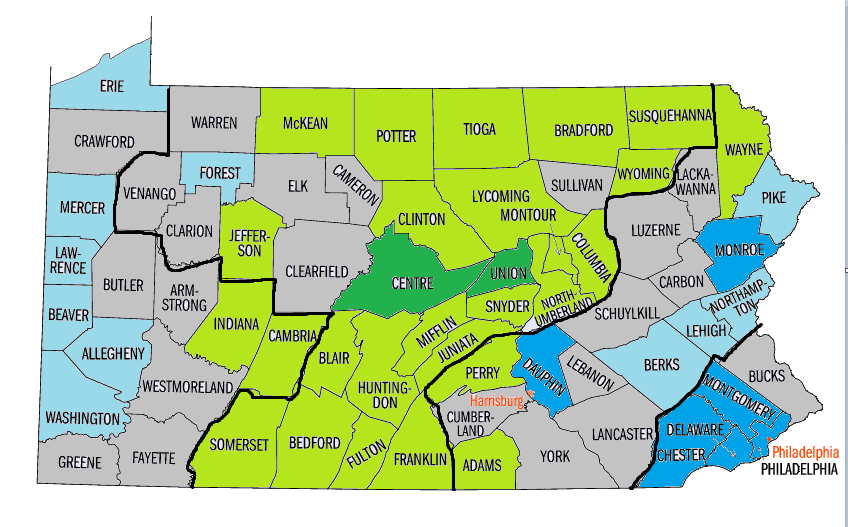
Pennsylvania primary divided.png
Philadelphia Map 
Dark Blue = Strong Clinton
Light Blue = Leaning Clinton
Grey = Tossup/not enough data
Light Green = Leaning Sanders
Dark Green = Strong Sanders
The dark lines represent my divisions between the Philadelphia metro, Eastern PA, Rural PA and West PA.
Philadelphia  Metropolitan Area:
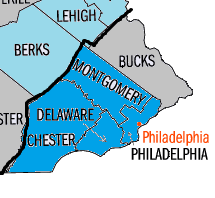
Philadelphia suburbs.png
Philadelphia Metropolitan area 
With the largest minority percentage in the state, a high population of wealthy white voters and a similarity to New York areas Secretary Clinton won, the Philadelphia metropolitan area should be Secretary Clinton’s strongest area in the state.
Philadelphia:
In 2008, Philadelphia was President Obama’s strongest county in the Pennsylvania primary. In 2016, it will likely be Secretary Clinton’s strongest county in Pennsylvania. The reason is that Philadelphia is 45% African American, 13% Latino and 35% White. With Secretary Clinton’s 75%-25% margin with African American voters in NY  and 60% win in Brooklyn with a 34% African American population, Secretary Clinton  will likely overperform that 60% number and could win 65% in Philadelphia, a reversal from Obama’s 65% win there in 2008.
Delaware County:
With a generally wealthy population and a 21% African American population, Secretary Clinton should expect a strong win here similar to Westchester County which has similar demographics with upscale white voters and African Americans. Secretary Clinton may not win here 2-1 where she did in Westchester but a 61%-62% win here is very possible. This could be Secretary Clinton’s best or one of her best counties in the state.
Montgomery County:
I expect a Hillary win here due to the similar demographics to wealthy NYC suburbs but with a lower African American population (9%) and a large college  aged population (Lower Merion Township). Sanders could keep it narrower here than Delaware County but barring a massive Secretary Clinton collapse he should be unable to win here. The wealthy Democrats as shown in Nassau and Westchester Counties should back Clinton.
Bucks County:
If Sanders carries one county in the Philadelphia suburbs, it will likely be this one. Bucks County is 85% White and has many liberal upscale white voters. It also has  more working class voters as well. Still, I expect a Clinton win although I expect it to be narrow.
Eastern Pennsylvania:
Eastern Pennsylvania.png
Eastern PA 
This area represents the counties west of the Philadelphia metropolitan area and east of the rural areas in the Appalachian Mountains. The cities in this area include: Harrisburg, Reading, Allentown/Bethlehem and Scranton. Secretary Clinton should perform well in these areas (although not as well as the Philadelphia metropolitan area) with help from the growing Hispanic and New York transplant population.
Lehigh/Northampton Counties:
I am grouping these two counties together due to being neighbors and similar in demographics. While Allentown/Bethlehem may appear to Sanders country at first due to being heavily working class towns, they also have a rapidly growing Hispanic population and in Lehigh County, the White population recently dropped below 70%(and the Hispanic population increased above 20%). These demographic changes should allow Secretary Clinton to win here.
Dauphin County:
With an 18.7% African American population (that helped propel Obama to a 58%  win here in 2008), Secretary Clinton should perform well  here. I expect a 55%-56% here for her. Harrisburg, the capital of Philadelphia is located here but unlike Albany (which Sanders narrowly won), it has a larger African American population.
Berks County:
After the Allentown area, Berks County is the most heavily Hispanic part of Pennsylvania. I expect Hillary Clinton to play well here, although I do not expect her to win by a large margin.
Lackawanna County:
While Scranton, a heavily working class area could appear to Sanders territory at a first glance, Secretary Clinton has some advantages here. She won 73% in 2008 here, Scranton has demographic similarities to the Youngstown, OH area Secretary Clinton won and her ancestors had roots here, something she highlighted in her 2008 campaign. While Sen. Sanders’s economic message will resonate with many voters here, it may be enough to keep it close but not enough to win.
Monroe County:
This county has had one of the most rapid demographic changes in Pennsylvania in the last couple of decades. Many New York transplants have moved in here and the Hispanic and AFrican American populations have increased to 15% each. The New York transplants moving in though are mostly upscale retirees who are more similar to Westchester County voters than southern Staten Island voters so they are more likely to support Secretary Clinton. The demographic trend is similar to a lesser extent in nearby Pike County as well.
Rural Pennsylvania:
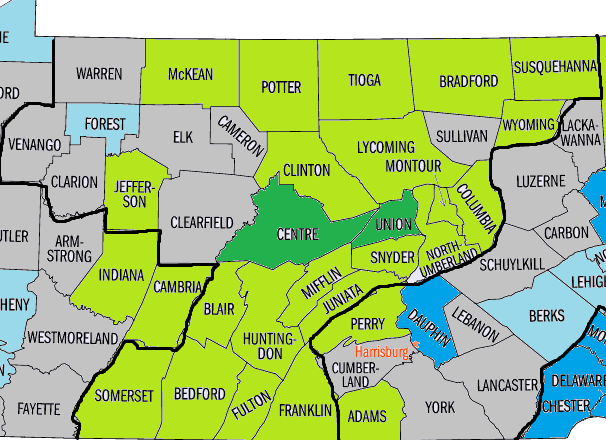
West Pennsylvania.png
Rural PA 
James Carville once said, “Pennsylvania is Philadelphia in the East, Pittsburgh in the West and Alabama in the middle.” Central Pennsylvania may not have a large African American population similarly to Alabama but may be similar in other ways. One of the ways it is not similar though is in Secretary Clinton’s margin. She won Alabama with 78%, that will not happen here. This is Sanders’s best chance to win a region of Pennsylvania. I expect the votes in this area to be more similar to central rural Upstate (strongly pro Sanders) than to Ohio or western New York (narrowly pro Secretary Clinton). I listed many of the rural PA counties as “leaning Sanders” because most of the Upstate counties bordering PA supported Sanders but by narrow margins so I expect the central rural part of the state to vote roughly 54%-55% Sanders.
Centre County:
This could be Sen. Sanders’s best county in Pennsylvania. It is home to “State College” where Penn State is located and has a large rural population as well. There is a little diversity but Sen. Sanders’s strength with young voters should give him a win of around 60% here.
Sullivan County:
Secretary Clinton has the potential to pull off an upset here. The reason is that 27% of the county’s population is 65+ and polls such as NBC/WSJ/Marist and Monmouth show her leading 66%-28% among 45+ voters and 57%-33% respectively among 65+ voters respectively giving Secretary Clinton a chance to win rural counties such as Sullivan County.
Pittsburgh/West Pennsylvania:
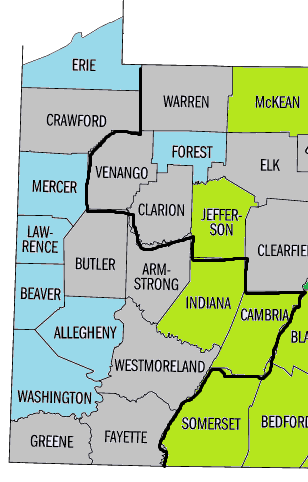
West Pennsylvania actual.png
West PA 
Western Pennsylvania should vote similarly to eastern Ohio and western New York. As shown by the numbers in Ohio and Western New York, western Pennsylvania will most likely be close but I expect a narrow Clinton win here. The reason  is that although Sanders did win most of western New York, his margins in Chautauqua County and Niagara County were narrow. These eastern Ohio results show that Secretary Clinton appears to do better in more urbanized working class areas while Sen. Sanders appears to do better in more rural ones as shown by Central New York. Also, the 65+ percentage of the population is higher here than in most Upstate counties. Central New York also has many similarities to Vermont, Sen. Sanders’s home state. Furthermore, many of the West PA Democrats tend to be more conservative than the rural Upstate voters who are more liberal.
Allegheny County:
With a 13% African American population and a small but growing base of wealthy white voters, Secretary Clinton could win here with a 10%-12% margin. Similarly to the 2008 primary, I expect Allegheny County’s results to mirror the state’s. With an African American population of 13%, working class white voters and upscale white voters, Allegheny County is a good representation of the state in the Democratic primary.
Erie County:
The Erie County in New York (with Buffalo) voted for Secretary Clinton by one point. Erie County, PA should be close as well with bordering Chattaqua County in NY voting for Sen. Sanders by eight points and Ashtabula County on the west voting for Secretary Clinton by 10 points. Overall, I expect a narrow Secretary Clinton win here but I would not be surprised if Sen. Sanders won here.
Conclusion:
Overall, I predict another Secretary Clinton win in PA, this time by 10-12 points.
Philadelphia area: Secretary Clinton wins Philadelphia overwhelmingly, wins all the suburbs with Bucks County being close.
Eastern Pennsylvania: Secretary Clinton wins most urban areas, she wins strongly in the Harrisburg area but might lose the Scranton area.
Rural Pennsylvania: while Sanders is likely to win, look for upsets in counties that are 20%+ 65 and older such as Sullivan and Forest Counties.
Western Pennsylvania: Secretary Clinton is likely to carry it due to the higher percentages of older voters than in Upstate New York and demographic similarity to Ohio counties that she narrowly carried.

Tuesday, April 12, 2016

Key Counties to Watch in the New York Primary


On April 19th, the New York primary will take place. Donald Trump is expected to win on the Republican side but on the Democratic side, if Secretary Clinton wins here and she wins with a large margin (10% or more), she could solidify her position as the frontrunner and make her delegate lead nearly insurmountable in top of the media fallout that would have occurred if she were not victorious.

Sen. Sanders has had a string of wins and is hoping that if he wins New York, the win can generate momentum to carry California and then give him the imputes to persuade super delegates to support him. At the same time, Sen. Sanders  needs to win 56% of the remaining delegates and if he loses New York by more than 10 points, not only does the delegate deficit  become larger, he loses the momentum he needs for any success the campaign would have. The RCP polling average shows Secretary Clinton with a 14 point lead, showing  she is on track to win with the margin she needs.   Furthermore, one of the most demographically favorable states for him, Wisconsin went for him by 14 points, barely above the 12 point average he needs through the rest of the contest and not enough for any significant changes in the race for the nomination.

This article is  a county by county analysis showing which counties and demographic groups to watch on Election night.

Sen. Sanders’ strategy: Win crushing margins in Upstate, especially in the 21st district (near Vermont), keep Hillary’s margins in the New York City Boroughs low, win Manhattan and win Suffolk County. Also outperform the Teachout map (Zephyr Teachout  was a Progressive primary challenger for Governor Cuomo in 2014 and lost by 28 points but played well with white rural upstate voters).
Teachout vs. Cuomo Map:
Yellow = Cuomo
Green = Teachout

Secretary Clinton’s strategy: Win all five boroughs, win overwhelming margins  with African Americans and Latinos, win Suffolk County, win the Lower Hudson River Valley, win all major urban areas Upstate and surprise the pundits by winning some rural counties Teachout won.  

Predicted County Map for the New York Primary:
New York Map election.png
Dark Blue = Clinton
Light Blue = Sanders
Gray = Too close to Call/not enough information

New York City Boroughs:
New York City.png
Brooklyn:
Yes, Brooklyn may be famous for its hipsters and I am sure we all know which Democratic candidate  hipsters will back. At the same time, Brooklyn has a large African American population (34%) and a large Jewish population (23%). Many of those Jews are Orthodox and as shown by Hillary’s margins in heavily Jewish Palm Beach County in Florida, she is very popular with New York Jews. A Fox News poll also showed her with a 59%-35% lead among Jews, and it is probably higher with Orthodox Jewish population. While Sen. Sanders may play better with younger and more secular Jews in Manhattan, there are many Orthodox Jews in Brooklyn who should wind up voting for Clinton. My grandmother grew up in Brighton Beach so I have a genuine  connection to Brooklyn and have learned very much about the Brooklyn culture from her. Secretary Clinton won Brooklyn by under one point in 2008 vs. then Sen. Barack Obama despite performing poorly with the African American community.  With the added support from African Americans, Hillary should increase her margin and win Brooklyn with 58%-60% of the vote.  

Staten Island:
On paper, Staten Island should be Sen. Sanders country. It is white and working class. At the same time, it should support Secretary Clinton because many Democrats here are generally conservative and also, there is a growing minority population as well that would keep the Sanders numbers lower than anticipated.

Manhattan:
While Sen. Sanders may not win Manhattan, this is the borough he would have the best chance to win. The reason is that while many voters here may be the “limousine” liberals that would potentially vote for Sanders, there are large numbers of college students in NYU and Columbia that would vote with Sanders. Secretary Clinton will likely win Manhattan due to strong support from Harlem and Washington Heights (Manhattan has an 18% African American population and a 26% Hispanic population) but it could be close.

Queens:
Sen. Sanders may play better here than Brooklyn but the 21% African American and 28% Latino figures do not help him. Still I expect a tighter margin here than in Brooklyn (about 56%-57% for Secretary Clinton). The reason is that Queens is 25% Asian and Bernie has been shown to perform better with Asian voters than African American and Latino voters.

Bronx:
If Secretary Clinton’s margins with Puerto Ricans are similar to her Floridian margins with Puerto Ricans (many Floridian Puerto Ricans moved there from New York), expect a resounding performance here, with about 65% of the vote. If Sen. Sanders does better than expected  among Latinos (one poll shows a tie while others show Secretary Clinton leading with Latinos), expect a Secretary Clinton win but narrower (57%).


Suburban Counties:
New York suburbs.png

Nassau County:
Attacking Wall Street works across most of the country but in Nassau County with cities such as Great Neck and Oyster Bay with large Wall Street populations, it definitely does not. Secretary Clinton should win Nassau County and having heavily African American Hempstead in the county does not hurt either (Nassau County is 13% African American).

Rockland County:
Despite being Jewish, Sen. Sanders has struggled to perform well with older and Orthodox Jewish voters (but plays better with secular, younger and Progressive Jews) as mentioned earlier. Due to the high Orthodox Jewish population in Rockland County with a 31% Jewish population (highest % of Jews in any county in the U.S), I would expect a solid victory for Secretary Clinton.

Suffolk County:
If Sen. Sanders wins one suburban county, it will be this one. The African American and Hispanic populations are lower here. There is also less wealth here than in Nassau County and many of the middle class south shore voters may be open to Sanders. If Sanders fails to win Suffolk County, expect a bad night for him.

Westchester County:
Besides being Secretary Clinton’s home as a Senator, Westchester County was almost made for her. Not only does it have a sizable African American and Latino population (16% and 24% respectively), it also has large number of wealthy white voters. Those voters are Secretary Clinton’s strength (as shown in the Massachusetts suburbs on Super Tuesday) so she should perform well here.

Upstate New York:
Upstate New York.png
I expect Sen. Sanders to play  well here and win most of the central rural counties, due to the high number of progressive rural white voters and proximity to his home state Vermont (yes, I expect Secretary Clinton to lose “Clinton County” because it borders Vermont and has the demographic profile of counties Sen. Sanders wins). Secretary Clinton though has relationships in Upstate Counties and performed well in the 2008 primary. The NBC poll shows Sen. Sanders with a 1 point lead in Upstate, suggesting a close race here. The counties where Secretary Clinton can perform the best include:

Erie County (Buffalo):
On March 15th, Secretary Clinton surprised many pundits by not only winning Ohio but winning by 14 points and winning urban areas that faced large manufacturing job loss such as Cleveland and Toledo. Buffalo is similar demographically to many of those Ohio cities and Erie County has a 13% African American population, suggesting Secretary Clinton should play well here.

Albany County:
Due to the 12% African American population and large number of voters here involved in New York politics (New York politicians and political workers are firmly behind Secretary Clinton), I expect she will carry Albany County.

Monroe County (Rochester):
With the 16% African American population and similarity to Buffalo, Secretary Clinton  should win here as well.

Orange County:
This county is a fine boundary between Upstate and Downstate with a small population of Jewish voters, some Latinos (19%) and some African Americans (12%). I expect a Secretary Clinton  win here due to demographics and Orthodox Jews in places such as Kiryas Joel but the progressives here may keep it close for Sen. Sanders.

Other borderline Upstate/NYC Metro Counties: I expect Secretary Clinton to win Putnam County due to the high income level of the voters. The counties Bernie should win include Dutchess and Ulster (Secretary Clinton won Ulster by only 3 in 2008).

Conclusion:
Overall, I expect a 10%-15% win for Secretary Clinton in New York. Her ability to win demographic groups such as African Americans, Latinos and Jews will be extremely helpful here, as well as Bernie’s stalled momentum after the Daily News Interview, the delegate tie in Wyoming (most pundits expected a blowout there), and the “not qualified” comment he recently made.

Here is how I see New York Regionally:
Secretary Clinton will most likely win all five boroughs with the closest being Manhattan..
Secretary Clinton will win all the suburban counties with the possible exceptions of Suffolk and Orange Counties.
Secretary Clinton will lose in Central Upstate due to the Progressive streak and proximity to Vermont but may do well in Western New York (Buffalo, Rochester) due to the similarities to the voters she won in Ohio and relationships she previously built as Senator.

Friday, November 1, 2013

Virginia 2013 Governor Election Guide

2013 is an odd numbered year which means that there are no major U.S. House, Senate or Presidential elections (except for a few specials) so it is a relatively quiet year. There are two major Gubernatorial elections though and those are in New Jersey and Virginia. In New Jersey, the RCP average shows Republican incumbent Chris Christie ahead by 25 points due to goodwill from his Hurricane Sandy response (the effects still impact New Jersey today.) Virginia though has a streak of not electing a Governor of the same party as the incumbent President since the 1970s but a combination of factors look to break that streak. Virginia's demographic changes in Northern Virginia as well as Republican Gubernatorial candidate State Attorney General Ken Cuccinelli's (R) stands on social issues are helping former DNC chair and friend of the Clintons Terry McAuliffe (D) lead Cuccinelli in every poll since July (even polls conducted by Republican leaning firms such as Rasmussen.) Cuccinelli also seems to have realized he is in trouble, he recently tweeted that "the only poll that matters is Election Day." This is one of the six things losing candidates say according to well known political analyst Staurt Rotheberg. Others include "I'm the next Scott Brown" and "My son is running my campaign."

The two other statewide offices up for a vote in Virginia are Lieutenant Governor and Attorney General. For Lieutenant Governor, State Senator Ralph Northam (D) is posting double digit leads. Those leads grow as Virginian voters learn more and more about his opponent E.W. Jackson's views which include that "gay people are perverted and psychologically sick"  and that Planned Parenthood is the "KKK" When a reporter asked Jackson why he made these statements, he pretends he never said them. That strategy however is not working as Northam continues to lead. 

The Attorney General's race is much closer though where it is a contest between two State Senators named Mark. The Democrat, Mark Herring (D) is from Loudon County, the main bellwether county in Virginia (since 2001, only one Virginia general election candidate has won without carrying Loudon County.) Herring's record includes working on fixing transportation issues and bringing tech jobs to Northern Virginia. His opponent, Mark Obershain (R) is from the Shenandoah Valley, one of the most conservative areas in Virginia. While the other two statewide offices are locked up for the Democrats, this race has been close, mainly because Obershain is more moderate than Cuccinelli and Jackson. The Attorney General race is important policywise if there is a lawsuit against the gay marriage ban because the Attorney General can decide not to defend the ban. Also, the Attorney General of Virginia is important for other issues. For example, Cuccinelli in 2010 sued the U.S. Government over the Affordable Care Act and brought the case to the Supreme Court. 

This post overall will be devoted to dividing up the areas in Virginia and explaining how well Herring needs to perform in order to win. 

(map is courtesy of U.S. Census Quick facts. The author is responsible for coloring the regions.) 

Virginia can be divided into 7 regions:
1. Inner core (Dark Blue)
2. 1st Ring suburbs (Light Blue)
3. 2nd Ring suburbs (Purple)
4. Exurbs (Red)
5. Tidewater/Hampton Roads (Green)
6. Richmond Area (Yellow)
7. Rural Virginia (Gray)

The Inner core:
The Inner core includes Arlington and Alexandria, the first areas to experience suburban growth from Washington D.C. in the 1970s. These areas have large numbers of well educated professionals, many of them white. D.C. is famous for having 80%+ of its white voters voting Democratic and many of those voters have moved to Arlington and Alexandria.

For Dems:
These voters fit McAuliffe's business and D.C. connection profile well and while he will overperform in Virginia as a whole, there needs to be high turnout here to carry Herring over the top.

1st Ring suburbs:
Fairfax County would constitute that 1st ring of suburbs. The voters here are also mainly well educated professionals who are socially liberal and fiscally moderate. There is a fast growing immigrant community of Hispanics and Asians in Fairfax County. Back in the 1980s and the 1990s, Fairfax County grew as families (including mine,) left Washington D.C. Fairfax County used to be a heavily Republican bastion that even  Lyndon Johnson and Bill Clinton failed to win. In 2004 though, Fairfax County voted Democratic Presidentially for the first time in decades with Kerry winning 53% of the vote. Part of this was due to the trend among socially liberal suburbanites toward the Democrats as the Republicans shifted right on cultural issues. The influx of Asians and Hispanics helped the Democrats even further while the more conservative voters moved out into the exurbs and the 2nd ring.

For Dems:
McAuliffe should overperform here because he is the kind of Democrat that this area will support. He is white collar, well educated, a successful businessman and he has ties to Washington (many of the residents here are involved in the Government.) Northern Virginia is famous for propelling these kinds of Democrats such as Mark Warner (D) in the 2001 Gubernatorial race and Jim Webb (D) in his 2006 Senatorial race to victory in extremely close races. If a Republican emphasizes the economy and his business credentials though, they can win as Bob McDonnell (R) showed when he won Fairfax County in 2009. McAuliffe though is the right fit for this area and Cuccenelli's social issues extremism should hurt him here. McAuliffe could win about 65% of the vote here if he wins more than 55% statewide. Cuccenelli though is a former State Senator from Fairfax County so it will be important to see whether latent goodwill here will trump over his social extremism.

2nd ring suburbs:
Prince William and Loudon County used to be heavily Republican counties but have become bellwethers. The counties themselves are both swing counties but are very different from each other. Loudon County is very upscale (a 100k income here is considered average,) is 65% White with the other 35% being a mix between Hispanics and Asians. The Democrats here are socially liberal while the Republicans here are economic conservatives similar to the Wall Street voter (there are a few evangelicals in the western part of the county but their presence is diminishing.) In Prince William County, the scene is different with many evangelicals and Hispanics and African Americans. President Obama won 57% here in 2012 due to the turnout among African Americans and Hispanics but this should not be taken for granted as a Democratic area. Turnout rates among minorities usually drop in non Presidential elections.

For Dems: In 2012, President Obama won Loudon County (albeit very narrowly) even though Romney connected with the upscale economic conservatives due to the area's large Asian vote swinging strongly for Obama. McAuliffe can overperform Obama among the economic conservatives and Loudon County is the perfect county to test if Obershain is associated enough with Cuccenelli. In Prince William County, McAuliffe must increase turnout among the African Americans and Hispanics who are the main Dem voter base there.

Exurbs:
This area includes Faquier, Stafford and Spotsylvania Counties. These are counties boarding the 2nd ring suburbs of Washington D.C. They are a mix of rural and new subdivisions. Unlike the inner suburbs, these areas are less diverse and have more in common with rural Virginia than they do with Fairfax County. These areas are not as Republican as other exurban areas are including the Atlanta suburbs but they still lean in a Republican direction.

For Dems: Although voters here are not socially liberal, it is possible McAuliffe can win Stafford or Spotsylvania Counties if Cuccinelli's implosion in the polls translates into votes. Herring should not expect to win any counties here but should be able to at least reach the mid 40s in Stafford and Spotsylvania Counties. If he is unable to do so, it will be problematic for him.

Tidewater Virginia:
Tidewater Virginia is also known as the Hampton Roads Region. This area has a strong military presence and a large African American population, creating a perfect swing area. The major Democratic areas are Norfolk, Portsmouth, Hampton and Newport News while the more Republican areas are York County and Virginia Beach. The swing areas are Suffolk and Chesapeake. President Obama won both areas in his 2008 and 2012 elections and barely lost Virginia Beach both times. In 2004, Kerry lost both areas, however. Democrats such as Senator Tim Kaine (D) have done well here too while the African American population turned out strongly for President Obama.

For Dems:
Herring needs to win Suffolk and come within 1-2 points in Chesapeake. Republicans may overperform here a little bit because McAuliffe does not have the same appeal among African American voters that President Obama did which caused them to turnout in high numbers for him and therefore help other Dems such as Kaine in 2012. Kaine in 2005 still performed well here despite average African American turnout levels because he was able to win over swing voters here though. This is very doable for Herring because of the Government shutdown which Cuccenelli supported. Government employment is high here so the shutdown is a major issue and with the shutdown ending less than a month before the election, this issue hurts Republicans.

Richmond:
The Richmond metropolitan area appears similar to the Hampton Roads demographically at first with a large African American population but many of the white voters here are more upscale and not associated with the military. In 2008 and 2012, President Obama overperformed here due to the high African American turnout which will not be as high in 2013 but the white voters here are not as socially conservative as rural white voters so it is possible that the swing voters here will break strongly for the Dems.

For Dems:
Henrico County is the bellwether county here, it used to be heavily Republican but African American voters moving in there from Richmond have caused it to become a swing county (and even a few points more Dem in certain elections such as the 2008 and 2012 Presidential elections.) Herring needs to win Henrico County, the last Democrat to win statewide and lose Henrico County was Jim Webb in 2006.

Rural Virginia:
Rural Virginia is a large area and while a few parts of it are Democratic (Charlottesville with UVA in Central Virginia, a few counties in Southeast Virginia with high African American populations,) it is primarily Republican. It is trending that way too. For example, Buchannan County in Southwest Virginia voted 66% for Romney but voted for Kerry in 2004. The area is socially conservative so unless McAuliffe decimates Cuccinelli, Buchannan County should stay Republican. The white voters in rural Virginia are mostly conservative and in southwest Virginia (this area is demographically similar to West Virginia with working class white voters who are trending Republican,) are becoming more Republican. This area one could say has more in common with Alabama than with Fairfax County.

For Dems: Rural Virginia is the Republican base so Democrats should not expect to carry it unless McAuliffe has a large double digit win. The bellwether county for Herring is Montgomery County where Virginia Tech is located. Montgomery County is in Southwest Virginia but the college voters in Virginia Tech have helped the county become a swing county.

Overall, while watching the election results, here are a few tips to keep in mind while watching for the Attorney General race.
1. Is McAuliffe winning by extremely high single digits or double digits? If so, this is good news for Herring.
2. Is Herring performing well in Loudon County? While Loudon County normally is a bellwether, Herring needs to overperform there because it is his home and he will receive a regional bounce.
3. Is Herring winning Henrico County? If he is, it means that the African American turnout is high and he is winning over enough Richmond area white voters.

Keep these in mind in order to determine who the next Attorney General of Virginia will be.

Tuesday, October 30, 2012

Electoral Vote Ratings: One More Week

My previous electoral vote ratings: http://racesandredistricting.blogspot.com/2012/10/electoral-vote-rankings-obama.html

These are my 2nd to last Electoral rankings. My last will be right before election day. 

http://racesandredistricting.blogspot.com/2012/09/electoral-vote-rankings-2012.html  has more detailed writeups on Safe and Likely states. 

Also, I have eliminated the tossup category because I believe at this stage, states are either trending one way or the other.


Dark Blue = Safe Democratic
Blue = Likely Democratic
Lean = Light Blue
Tilt Democratic = very light blue
Tilt Republican = Light red
Lean Republican = Orange
Likely Republican = Red
Safe Republican = Very Red

Changes favoring Democrats
Colorado-Tossup-Tilt D 
Connecticut Likely D-Safe D

Changes favoring Republicans
Florida-Tossup-Tilt R
New Hampshire Lean D-Tilt D


Safe Democratic (179 electoral votes)
CA, CT DE, DC, HI, IL, ME, MD, MA, NJ, NY, RI, VT, WA, NE, ND, OK,

Likely Democratic (22 electoral votes)
 MN, NM, OR

Lean Democratic (52 electoral votes)
MI, NV, PA, WI

Tilt Democratic (52 electoral votes)
CO, IA, OH, VA

Tilt Republican (44 electoral votes)
NC, FL

Lean Republican (11 electoral votes)
AZ, 

Likely Republican (37 electoral votes)
GA, IN, MO, MT, NE-02

Safe Republican (129 electoral votes)
AL, AK, AR, ID, KS, KY, LA, MS, NE, ND, OK, SC, SD, TN, TX, UT, WV, WY

My projections for the lean and tilt states:
Lean D
MI O 53-46
NV O 53-46
PA O 52-46
WI O 51-47
Tilt D
CO O 50-48
IA O 51-48
NH O 51-48
OH O 51-48
VA O 50-49
Tilt R
FL O 49-50
NC O 48-50
Lean R
AZ O 45-53

More detailed writeups on the safe and likely states: http://racesandredistricting.blogspot.com/2012/09/electoral-vote-rankings-2012.html

Lean Democratic (56 electoral votes)

Michigan (16 electoral votes) On paper, Romney seems to have a real shot in Michigan. His family hails from Michigan and in 2010, Michigan took a sharp turn to the right as the Republicans won the Governorship, the State Senate and two U.S House seats. Obama is doing well here because he revived the auto industry after it seemed to be dead and Romney appeared out of touch with Michigan because he wrote an article titled, "Let Detroit go bankrupt." He also is famous for saying, "The trees are just the right height," when referring to how he remembered Michigan from his boyhood days. For Obama to win in Michigan, he needs a large African American turnout in Detroit and needs to perform well in the Detroit suburbs, especially Oakland and Macomb Counties. Romney needs a strong turnout in the western part of the state where the auto industry is less prevalent but the tea party is prevalent. Most recent polls show Obama leading in the high single digits but a shocker poll released recently shows Obama and Romney tied in Michigan. It is just one poll however so I do not trust it. If other polls however show a similar result, then I will be worried. 

Nevada (6 electoral votes) Most polls show Obama with a small lead here. Nevada also has a history of having polls underestimate Democratic strength because of the Democrats' strong ground game and the large number of cellphone only voters. Also, many Hispanics who speak Spanish only are harder to poll and they vote strongly Democratic. For Democrats to win in Nevada, they have to win 55%+ in Clark County (Las Vegas) which has a large fast growing Hispanic population. They also must win Washoe County which is a bellwether. Romney's numbers with Hispanics are extremely low but he may make up some ground with the large Mormon population in the rural areas (known as the Cow Counties.) It will be hard for Romney to compete with the Democrats' organization and the changing demographics though. Also, the early voting numbers are strong for the Democrats being 47% Democratic and 37% Republican with 20% of Nevadans having early voted by 10/26/12. The Democrats' advantage in Clark County is showing itself too with the EV being 50% D and 31% R. Also, no poll in the last year has shown Romney ahead in NV, I am not worried about this state as long as the volunteers keep working. Even one of Gov. Brian Sandoval's (R) staff members says he thinks Obama will win Nevada. If I were Romney, I would pull out of here. His ground game cannot compete with the Democrats' ground game here. 

Pennsylvania (20 electoral votes) Earlier this year, Romney hoped to make Pennsylvania competitive by winning over disgruntled working class voters in western Pennsylvania. With the revival of the auto industry though, it seems that Obama will hold enough western Pennsylvania voters to win statewide. For Obama to win, he needs to do very well in the Philadelphia area, win its suburbs and win enough western Pennsylvania voters. Republicans generally win elections in Pennsylvania by doing well in the center of the state and winning the swing area which is the cities between Philadelphia and the Appalachian mountains. Those areas include Harrisburg, Reading and Allentown/Bethlehem. Obama in 2008 won those areas and those cities usually vote a few points more Republican than the rest of the state so if Obama wins them, he wins statewide. Recently though, the Democrats put an ad buy in the Pittsburgh area but that may be for Sen. Bob Casey (D) who is facing an unexpectedly tough race. 

Wisconsin (10 electoral votes) Wisconsin has had a Republican surge recently with the election of Scott Walker (R) as Governor and the failed recall. The Republican trend may be explained by Democrats moving out of Wisconsin and other Midwestern/Northern States. Romney's pick of Rep. Paul Ryan (R) also put Wisconsin in play because Ryan is from Wisconsin. For Democrats to win in Wisconsin, they not only need to increase turnout in Milwaukee and Madison, they have to win the rural counties in the western part of the state. They learned this in the Walker recall when Walker performed poorly in Madison and Milwaukee but won because he overperformed in the rural parts of the state. Romney's Ryan pick seems to have helped Romney in Wisconsin. Obama has had small leads although not a single poll this month has shown Romney leading Obama in Wisconsin. Therefore, I am keeping Wisconsin at Lean Democratic. 

Tilt Democratic (37 electoral votes)


Colorado (9 electoral votes) Obama won here by nine points, more than his countrywide average and the demographics here favor Democrats so if Obama wins the Presidency, he's probably winning Colorado too. Colorado is divided between the liberal areas of Denver, Boulder and the Rocky Mountain ski areas and the conservative areas of Colorado Springs, west Colorado and the Plains. The important swing areas though are the suburban counties of Jefferson and Arahaphoe. Those areas are socially liberal but not fiscally liberal. 2010 Senatorial candidate Michael Bennett (D) won statewide by winning over socially liberal suburban women so Obama needs to do the same in order to win Colorado. Also, Obama needs to excite the youth vote in Boulder because they were an important part of his winning coalition. Polls have been showing a near tie in Colorado but this may actually be an advantage for the Democrats. The reason is that Colorado has many Democratic leaning young and Hispanic voters who are harder to poll because many of them do not use landlines or respond to polls (in the case of Hispanics, some polls do not have Spanish options so Hispanics who do not speak English well may not respond.) This underpolling showed up in the 2008 Presidential race where the RCP average showed Obama ahead by 5, he won by 9 and in the 2010 Senatorial race, the RCP average showed Ken Buck (R) +1, he lost by 2 points. Still, this state is very close and the Democrats should take absolutely nothing for granted. 


Iowa (6 electoral votes) Iowa seems Republican at first. It is mostly rural and mostly white like the heavily Republican states of Kansas and Nebraska. The large number of universities, family farms and farms producing ethanol balance out the conservative evangelicals in the western part of the state. Obama won statewide by 9 points, thanks to strong support in the eastern part of the state but the Republican base in western Iowa seems more excited this year, making it harder for Obama. Iowa though is still trending toward Obama, with Nate Silver giving Obama a 66% chance of winning due to polls showing a small lead for Obama. Also, early voting numbers have been strong here. One important note is that in 2008, polls showed Obama with a double digit lead but he won by only 9 so Republicans can overperform in polls here. 

New Hampshire (4 electoral votes) New Hampshire has a strong libertarian streak and Romney did very well here in the primary. The Republicans' views on social issues have gone too far to the right to win over enough New Hampshire voters. Romney needs to win New Hampshire by doing will in Hillsborough and Rockingham Counties but since the Republican party brand is unpopular in New Hampshire this year (Democrats are looking to regain both house seats,) Obama should have an advantage. Romney's moderation though is helping him personally because he pulled close in a few polls last week and even led in a few. The most recent ones suggest Obama is coming back and RCP has him leading by 2.0

Ohio (18 electoral votes) Ohio is a state where I first thought Obama would fare poorly because he is not too popular with the state's large working class population. Romney however seems more out of touch with them and his opposition to the bailout which resurrected the auto industry does not help either. Obama is benefiting from the auto industry's revival and Ohio's low unemployment rate. This could help him in the important swing areas in Ohio he needs to win. For Obama to win Ohio, he needs high turnout in Cuyahoga County (Cleveland,) Franklin County (Columbus,) Summit County (Akron,) and Lucas County (Toledo.) The swing areas include Hamilton County (Cincinnati,) the rural counties between Toledo and Cleveland and the rural counties along the Ohio River. Anyway, Obama was doing well here in late September but after the 1st debate, polls showed a closer race. Obama regained his lead though, only one poll conducted since October 17th has shown Romney in the lead out of 18 polls released since then. All polls do show a 20%+ lead for Obama among early voters though, suggesting his ground game is very strong in Ohio. 


Virginia (13 electoral votes) Obama won Virginia by seven points in 2008, Obama won the Presidency by seven points in 2008. It seems that Virginia will be a tipping point state again this year with the RCP average showing Obama with a 1 point lead there. Virginia has done well under Obama though with a lower than average unemployment rate. The Obama Administration's Defense spending has helped create jobs here due to the military presence of the Pentagon and in the Hampton Roads area. For Obama to win here, he has to win big in Northern Virginia which has helped Virginia trend Democratic as immigrants and upper middle class families from DC (like my family,) moved out to the suburbs to raise their kids. Also, he needs to increase African American turnout in the Richmond and Hampton Roads regions which have large African American populations. Republicans need to rely on their base of rural southwest Virginia and win the exurban counties surrounding the urban Democratic areas in Northern Virginia and Richmond. The bellwether counties include Loudon and Henrico Counties. Loudon County is the nation's 4th fastest growing county and has a mix of rural conservatives with Asians, Hispanics and residents from the inner DC area. Loudon County was crucial for Jim Webb's (D) successful Senate election in 2006 as well as Tim Kaine's (D) successful Gubernatorial election in 2005 because Loudon County shows whether rural Virginia or suburban Virginia turned out stronger. Henrico County is a Richmond suburb which has a large African American population and if Obama wins there, it shows he has successfully increased African American turnout. Virginia looks to be decided by less than 1 point though. The southwest part of the state which delivered the 2004 election for Bush is turning out strongly but the African American community in the Hampton Roads is energized as are the Hispanics in Northern Virginia so it will be very close in Virginia. Polls seem to show Obama getting a small lead here. 


Toss Up/Tilt Republican (15 electoral votes)


Florida (29 electoral votes) Florida was a pure tossup back in August but seems to be slightly tilting towards Romney. Demographically though, Florida is divided into three distinct regions. The Gold Coast, the I-4 Corridor and the rest of the state. The Gold Coast is southeast Florida (Palm Beach, Broward and Miami Dade Counties,) which is filled with Jewish retirees, African Americans and Cubans. The area usually votes Democratic but Cubans in Miami Dade County usually prevent Democrats from receiving more than 55% of the vote in that county. Broward and Palm Beach Counties have less Cubans though and usually vote 60%-65% Democratic but turnout in those areas is crucial. In 2010, Gubernatorial candidate Alex Sink (D) barely lost statewide because turnout in Palm Beach and Broward Counties was low. Obama though has been working on outreach to Hispanics, especially non Cuban Hispanics. The non Cuban Hispanics have a large presence on the I-4 Corridor and helped swing it strongly toward Obama. They have a large presence in Orlando and Tampa and are a fast growing segment of the population. Also, many of them are Puerto Rican which means they are citizens and can vote so Democrats have lots of voters to register. Obama has around 70 field offices in Florida compared to Romney's 30 so Democrats definitely have an advantage on the ground. The third part of the state is the rest of the state which consists of rural northern Florida, Jacksonville and conservative retirement communities along the southwest Florida coast. Romney is expected to do very well in this area but if Obama can win Duval County (Jacksonville) which has a large African American population, he will probably win Florida. Overall, the polls show the race within 1 point of each candidate. Political analyst Nate Silver made an interesting point though, "Romney has only a 0.3% chance of winning the election without Florida." Silver is right and it also means if Obama wins Florida + Kerry states, he hits 275 electoral votes so Romney has to win 6 electoral votes from the Kerry states and prevent Obama from winning any state that voted for Bush in 2004 (with New Mexico and Nevada leaning Democratic this year, that looks pretty unlikely.) So if Romney wants to be President, he has to win Florida. Polls are showing a slight Romney lead but early voting started last Sunday and the Secretary of State is reporting high numbers for the Democrats. 


North Carolina (15 electoral votes)  North Carolina is trending Democratic demographically but I do not believe the Democrats are winning here this time. The reason is that in 2008, Obama completely maxxed out the turnout in Durham (which may not be repeated because the large numbers of young voters are less excited this year than in 2008,) Charlotte, the heavily African American northeastern part of the state and Obama still won by only 14,000 votes. North Carolina is a base state where Democrats and Republicans have to bring out their bases in order to win (Republicans bring out the exurban and rural white conservatives, Democrats bring out the college students and the African Americans,) instead of a state such as Iowa and Ohio where Democrats win by persuading voters. In 2008, the Republican base was not very excited and the Republicans barely even targeted North Carolina. All the Republicans need to do is erase a 14,000 vote lead and that should be pretty easy for them. I predict the demographic changes will help the Democrats make it close but I still see a 2-3 point win for Republicans here. Also, the early voting numbers look good for the Democrats with a PPP poll showing a tied race but a 57%-42% lead for Obama in the early votes. Most polls though show a slight Romney lead. The Romney campaign shifted one staffer from NC to OH and spun it as "pulling out of NC" but NC is still being contested by both campaigns, even if Romney has an advantage. 

Lean Republican (12 electoral votes)

Arizona (11 electoral votes) Earlier this year, the Obama campaign talked about putting Arizona in play. On paper, Arizona seems to be trending Democratic because it has a fast growing Hispanic population and lots of college students (Arizona State has 70,000 students, it is the largest public university in the country.) Also, Democrats are looking to gain two congressional seats too. Arizona though has a very conservative non persuadable base though in the Phoenix area who are strongly for Romney. Also, the state's Mormon population will boost him.  

So where do these rankings leave Obama? Although his path to winning seems more rocky than it did before the debate, Obama still has an advantage. He has maintained leads in the Gore/Kerry states which total 242 electoral votes. He also is ahead in New Mexico so the safe Obama states have a total of 247 electoral votes. To win, Obama needs 23 more electoral votes from the tilt Democratic or tossup states. Obama has been leading in Nevada so I will give him Nevada, giving him 253 electoral votes. From here, all Obama needs to do is win 17 more electoral votes. He can win that by winning VA + NH, NH + IA +CO, or simply win OH. Obama has strong leads in OH and IA so I would expect him to win those states. If he wins Gore/Kerry states, NV, IA and OH, he has 277 electoral votes which is enough to win. He is also leading in NH so he should get 281. The true tossup states are VA and CO and if Obama won both, he should win 303. From the looks of it now, Obama should receive between 281 and 303 electoral votes, enough to win.